Is the evolution of Germany’s Energiewende changing the views of Czech green activists?
Developments in Germany are dramatically changing Czech green activists’ views on the direction of energy policy in Europe. This is very clearly apparent in a recent article published by Milan Smrž, a well-known advocate of photovoltaics and anti-nuclear campaigner.
In Monday’s Deník Referendum, Mr Smrž analysed the Janus-faced nature of German energy policy. Not only this article, but also recent statements by some representatives of Czech green activist organisations, point to a rather dramatic shift in their positions. This is primarily driven by how the course of the German Energiewende is increasingly clearly demonstrating the real possibilities of different pathways to low-emission energy.
I consider this evolution in views not only interesting, but perhaps also significant for the future development of Czech energy policy. I therefore attempted to engage in a polemic with Mr Smrž’s article and confront it with a different perspective and facts he does not mention. I believe that a polemic should be published in the same outlet as the view it challenges. Unfortunately, in response to my request for publication, the editors of Deník Referendum stated that the entire editorial team holds one unified view on the matter, which is in line with Mr Smrž’s opinion. They added that they would not publish any other view in Deník Referendum. They advised me that if I wanted to publish the article, I should send it elsewhere. That is why my contribution is not appearing in the outlet that published the original article.
I have encountered Mr Smrž’s articles not only on the pages of Deník Referendum for several decades. Until now, they have been full of admiration for the German energy concept and calls for everyone to follow it, especially in the area of dismantling nuclear power. The current article represents a dramatic break in Mr Smrž’s views. Suddenly, it is not Germany but France and Sweden that are at the forefront of “progressive energy policy”. Suddenly, Germany is Janus-faced and a fan of fossil energy. However, Mr Smrž has forgotten to mention that France, Sweden, as well as Switzerland and the province of Ontario, for example, can phase out coal-fired power plants precisely because they have a combination of nuclear and renewable sources. One in which nuclear electricity makes up a significant part of the energy mix. Slovakia will soon also achieve this form of low-emission energy: it will close its last coal-fired source and, after bringing two nuclear units at Mochovce online, will cease to be an electricity importer. Finland will similarly move closer to this goal after commissioning the unit at Olkiluoto. The current emissions situation can be clearly seen online at https://www.electricitymap.org/. France, Sweden, Ontario and, thanks to its exclusively hydropower sources, Norway are always shown in green (minimal CO2 emissions). Germany, alongside Poland, is among the darkest areas for most of the time.
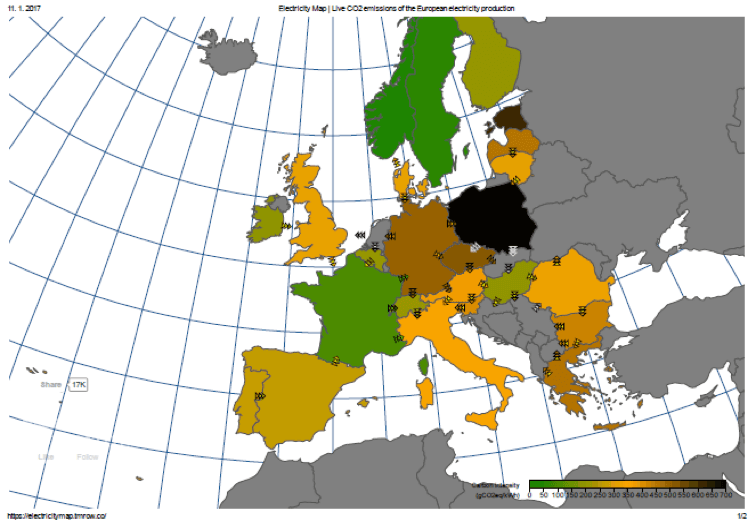
The online emissions display shows that countries using a combination of nuclear and renewable sources have low emissions and are coloured green(https://www.electricitymap.org/ ).
At the same time, Mr Smrž forgot to add that the need to use fossil fuels, including coal, in Germany is predominantly caused by the campaign of anti-nuclear activists like himself. They made dismantling nuclear power the top priority of their campaign. They achieved the launch of the Energiewende in 2000 under a German coalition government of the Greens and the SPD, with this stated top priority and the goal of closing nuclear units by 2022. One need only look at Mr Smrž’s articles and statements by similar Czech and German activists, who have long declared the need to end the use of nuclear energy. They proclaim that shut-down nuclear units can easily and quickly be replaced by renewables, and that replacing fossil fuels will then also be easy and quick. Even in his Monday article, Mr Smrž writes that there are only very few days without wind and sunshine, and that an energy system can be built entirely on a combination of these sources.
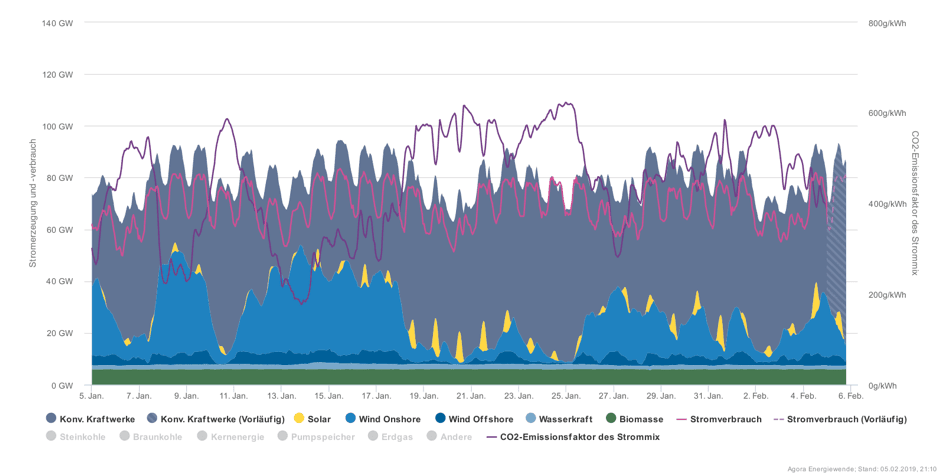
Agorameter data for the past month show that periods with little or virtually no wind are by no means exceptional. And in January, the sun really does not deliver much (green – biomass, very light blue – hydro, dark blue – offshore wind, lighter blue – onshore wind, yellow – photovoltaics, dark grey – conventional sources).
Germany, however, has found that this is not the case. It is enough to look at data from the recent December and January, when there were indeed quite a number of windless periods. Germany found that even after extreme expenditure and the installation of wind and photovoltaic capacity such that each could, under ideal conditions, provide almost all required capacity, in 2018 wind sources covered 20,3 % and photovoltaics 7,7 % of electricity generation. In the case of wind sources, these are predominantly large wind farms in northern Germany, near or at sea. In Bavaria, which is similar to us in terms of geography, population density and industrial profile, wind turbines generate only a few percent of electricity. At the same time, this was not a transition from centralised to decentralised energy, but precisely the opposite. Instead of nuclear power plants located directly in industrial Bavaria, it will be supplied to a large extent by large wind farms thousands of kilometres away on the Baltic Sea. For this to work, moreover, a number of very long extra-high-voltage transmission lines need to be built. In any case, after nuclear units are shut down, some of which will be replaced in Bavaria by gas-fired units, this federal state will change from an electricity exporter to an importer.
German politicians would very much like to close coal-fired power plants, but because of the closure of nuclear units this is really not possible, and will not be for a long time. The main reason is not concern about social problems caused by closing lignite mines. After all, 36 % of coal-fired electricity in 2018 was generated from imported hard coal, and hard-coal power plants are expected to operate into the 2030s.
The new modern Moorburg hard-coal power plant, which replaced a nuclear source in Hamburg, may operate until 2038 (source: Wikimedia, Ajepbah).
One further fact is important. Phasing out coal in Germany in 2038 (if it can be achieved) does not mean the end of fossil energy. Retired nuclear and coal-fired power plants will largely be replaced by gas-fired units. Their construction is already being prepared, and Germany’s transition to gas, mainly from Russia, is also to be ensured by the Nord Stream 2 pipeline under construction. Switching from coal to gas does bring a very substantial reduction in pollutants, but carbon dioxide emissions from its combustion fall only by roughly half compared with coal. However, if we take into account methane released during its extraction and transport, as well as methane’s greater impact on the greenhouse effect, the question is whether switching from coal to gas represents progress. Especially when some gas-fired sources will also replace low-emission nuclear sources. It is becoming clear that two possible energy pathways exist. One is a combination of nuclear and renewable sources, which enables a relatively rapid path to low-emission energy. The other is a combination of fossil (gas) and renewable sources, where the transition to low emissions remains uncertain. In any case, it will take a very long time.
Mr Smrž still presents Austria as a model worth following. But let us look at the real nature of that country’s energy system. Austria has an exceptional geographical advantage that allows it to generate a dominant share of its electricity in hydropower plants. Last year, run-of-river and pumped-storage hydropower plants generated a total of 62 % of Austria’s electricity. Wind generated only 11,6 % and photovoltaics 2,6 %, which, incidentally, is the same as coal. Fossil gas generated more than wind and photovoltaics combined, a total of 14,5 %. Sources using biomass accounted for around 4,7 %. Moreover, it should be recalled that Austria is a net importer of electricity, importing it for example from Temelín and Dukovany, as well as Polish coal-fired units.
This overview alone shows that Austria is highly specific, and no country without such excellent conditions for using hydropower can follow its energy mix. On the other hand, it shows that other renewable sources provide only a relatively small share of electricity in Austria, not all that different from the situation in the Czech Republic. If Austria did not have such hydropower opportunities, it would need a share of fossil or nuclear sources similar to ours.
Mr Smrž very often invokes the situation in the Austrian federal state of Burgenland. But what is the real situation regarding this region’s energy self-sufficiency? It should be noted that this is a very sparsely populated, poorly industrialised area dominated by agriculture. This makes it possible to meet its relatively low demand to a considerable extent with electricity from biomass, wind and sun. However, this is not an energy mix for much more populous and industrial regions such as the Czech Republic. Moreover, photovoltaic plants, wind turbines and biomass boilers are not manufactured in this region; they are imported. Thus, these energy-intensive facilities needed there must be manufactured elsewhere and using other energy sources. There can therefore really be no talk of this area’s genuine energy self-sufficiency.
The course of the Energiewende in Germany and its results in terms of carbon dioxide emissions are influencing the views of green activist organisations in the Czech Republic. In the 1990s and early 2000s, these organisations fought by every possible and impossible means against the completion and commissioning of Temelín, and then for its closure. Likewise, they advocated closing Dukovany after thirty years of operation, following the example of the German Energiewende. They regularly awarded the Ropák anti-prize precisely for efforts to use nuclear sources. In the end, however, it turned out that those so awarded were promoting an environmentally sound energy solution and enabling a significant reduction in carbon dioxide emissions.
Today, for example, the Czech branch of Greenpeace, through its head of energy campaigns Jan Rovenský, declares support for the long-term operation of both Dukovany and Temelín (more here). It thus admits that it was wrong for decades. Wealthy and determined Germany has clearly shown that fossil sources would in any case have had to replace Temelín and Dukovany in the Czech Republic. And for financial reasons, this would more likely have been domestic coal than imported gas. Green activists still oppose the construction of new nuclear units. Yet Czech Greenpeace may also change its view on this based on developments in Germany, especially Bavaria, after 2022, when the full shutdown of nuclear units takes effect. Numerous indications of what Europe faces can be seen this winter not only in Germany, but even more so, for example, in Belgium. It has experienced what life without nuclear power might be like.
Bavaria will clearly show us where a gas-based path without nuclear power would lead in the Czech Republic as well. The possible scenarios are defined by our options. Our hydropower potential is already almost completely exhausted, we have no windy seacoast, and photovoltaics do not account for even 10 % of generation in Germany either. The possible sources and their potential are described in great detail in a series of articles (wind, hydro, solar, nuclear, geothermal and storage). The analysis outlines possible pathways to low-emission energy and possible scenarios for Czech energy policy. For the Czech Republic, this means that it has, in principle, two basic options. Either it follows France, Slovakia or Finland towards low-emission energy based on a combination of nuclear and renewable sources, or it follows the direction shown by Bavaria towards a combination of fossil (gas) and renewable sources. In the latter case, however, especially when accounting for the entire gas production cycle and released methane, it is difficult to speak of low greenhouse gas emissions. If greenhouse gas emissions really bring the climate change and risks that are claimed, it would be good for green organisations to consider whether they are mistaken again and whether they should change their view on building new nuclear sources as well. Whether Mr Smrž and those like him, by making the fight against nuclear power their top priority, have caused carbon dioxide emissions from the electricity sector in Germany to be many times, even an order of magnitude, higher than in France. And whether they are not thus the main reason why emissions in Germany, Europe and the world are not as low as in France.
The history of energy policy in the Czech Republic and the development of the Energiewende in Germany also offer one very important lesson. Activists who, with faith and holy zeal, chained themselves to gates or railway tracks to prevent the use of nuclear sources were entirely successful in Germany and partly successful here (only two units were completed at Temelín). In reality, however, they caused Germany to close sources that had already incurred their carbon footprint and could have produced low-emission electricity for decades more. Instead of Germany already being almost or completely coal-free and having low emissions like France, it will continue increasing carbon dioxide levels for decades. And they have in reality contributed to our failure to meet the limits recommended by climate scientists. In other words, probably something entirely different from what they intended. This prompts reflection on whether, at least in scientific and technical matters as demanding as climate change and real pathways to reducing greenhouse gas emissions, knowledge is not more important than holy zeal and determination.