10 August 2026, 15:50
Possible paths to low-emission energy (part 2)
Vladimír Wagner
28 February 2018, 18:13
This article is a machine translation of the Czech original and has not yet been fully reviewed. In case of any doubt, please refer to the Czech version.
This is the second part of an article on Possible paths to low-emission energy. The first part can be found here.
The course of Germany’s Energiewende to date
Let us now take a closer look at the course of Germany’s Energiewende to date and what it indicates about its future development. Statistics show that the phase-out of nuclear power plants is progressing very successfully. This Energiewende objective is being met exactly according to plan. Following the shutdown of the first major unit, Grafenrheinfeld in Bavaria, in 2015, nuclear electricity generation continued to decline in 2016. Before the start of the Energiewende, nuclear power plants generated almost 160 TWh annually, roughly 30% of total electricity production; output has now fallen to around 80 TWh annually, well below generation from individual fossil sources, although still nearly 15% of total production. As recently as 2016, nuclear power plants generated more electricity than wind. However, all nuclear units were due to be shut down in 2022, and a substantial share of low-emission generation will thus disappear. Let us now consider what could replace it.
Germany’s electricity generation profile shows that hydro output has remained unchanged throughout the Energiewende, at roughly 20 TWh, or only around 3.6% of total generation. Some fluctuations are caused by changes in precipitation levels. Even intensive subsidy support for hydro resources has not helped, although it enabled the construction of numerous small decentralised sources that are very useful on the path towards small-scale, decentralised and efficient energy systems. However, they do not address the required significant increase in electricity generation that would make it possible to replace the loss of nuclear power.
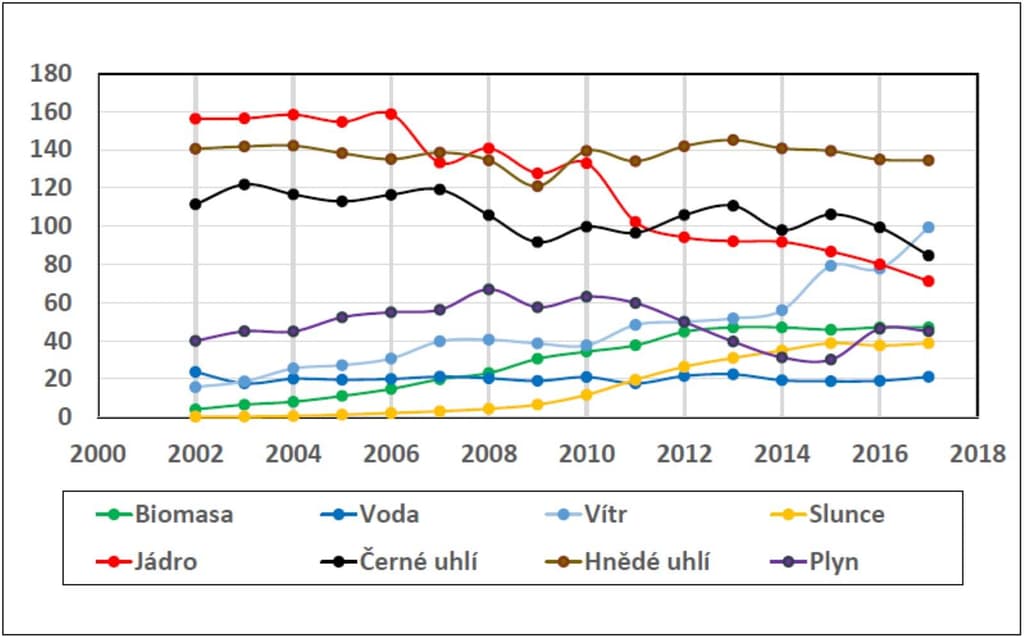
Another option is the use of biomass. In this case, there was a rapid increase roughly between 2004 and 2010. Since then, electricity generation from biomass has remained approximately unchanged at 47 TWh, just under 9% of total electricity generation. It has probably already encountered the limits imposed by competition with food production and the ecological functions of the landscape. Another factor is that Germany stopped subsidising such environmental excesses as transporting maize over long distances, for example from the Czech Republic, for highly subsidised biogas production for electricity generation, or burning imported wood in thermal power plants. Biomass and carbon dioxide emission reductions are problematic in general. Naturally, its combustion also releases emissions, both carbon dioxide and genuinely harmful pollutants. It is assumed, however, that this carbon dioxide will be absorbed from the atmosphere again as the biomass regrows. But if mature trees processed into wood chips are burned, the cycle takes up to eighty years, and it is questionable whether such use of biomass helps us now, when we are seeking rapid emission reductions.
Germany can therefore use only wind and solar power to replace nuclear energy. The question is to what extent this will succeed. In photovoltaics, after the rapid growth in both capacity additions and electricity generation from this source between 2007 and 2013, growth slowed markedly. Changes in annual electricity generation are thus mainly determined by weather conditions in a given year, and solar electricity output has remained approximately unchanged for four years, at around 37 TWh, or 7% of total generation. In 2016, it fell even though installed capacity increased by 1 GW. Here, the slowdown in both capacity and generation growth is most likely largely due to lower subsidised feed-in prices for electricity from this source. The key lesson from Germany for its use in the Czech Republic is that, even with installed capacity equal to total demand, this source supplies less than 10% of needs. Moreover, it is predominantly responsible for high renewable support charges in German electricity prices.
For wind resources, both capacity and generation continue to grow. In 2016, wind electricity generation was lower than in 2015, even though installed capacity rose by 5 GW. However, 2015 was highly exceptional, with output from wind sources rising very sharply. The increase in the year before last and the fall last year may therefore mainly be due to weather developments during 2015 and 2016. Wind sources supply 80 TWh in Germany, around 14%, but this is thanks to the windy northern coast. In Bavaria, which is very similar to the Czech Republic in geography and other characteristics, wind power plants supply only a few percent of its electricity needs. Those relying on wind power in the Czech Republic should bear this in mind.
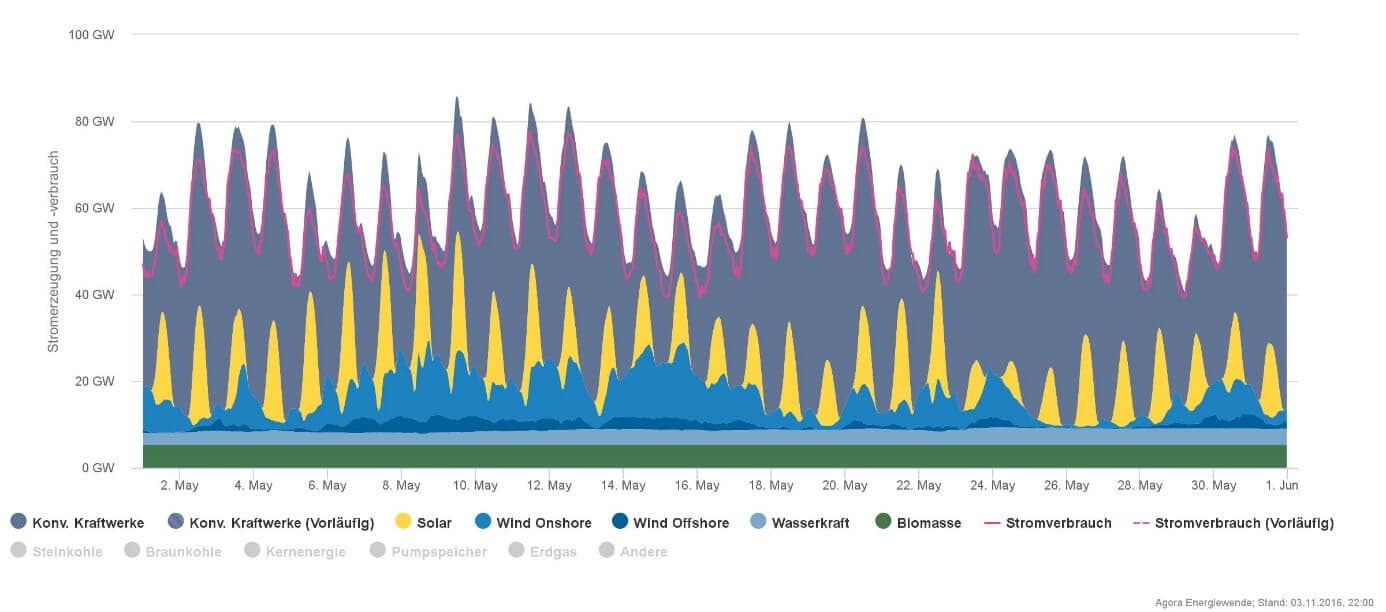
However, it is possible that two other factors are already beginning to predominate for these sources in Germany. Weather conditions are often the same across Germany and the Czech Republic, and these sources behave like one large power plant. Photovoltaic and wind capacity has already reached a level equivalent to Germany’s total demand. Especially in spring, when it is windy and sunny at the same time, Germany has huge excess generation and must increasingly curtail both wind and photovoltaic sources. At the same time, it lacks extra-high-voltage lines to transport electricity from northern wind farms to industrial Bavaria.
Germany currently has more than 40 GW of solar capacity and 50 GW of wind capacity installed. Its demand ranges between 50 and 80 GW, with actual values depending on the day of the week and time of day. Demand falls at weekends and on public holidays, and is also lower at night. There is a broad peak between 5:00 and 23:00, with maxima around 12:00 and then around 18:00.
We will therefore see how these factors affect the replacement of nuclear and fossil sources with wind and solar power in the coming years, when they become even stronger. The year 2016 was very interesting for assessing the possibilities and future of Germany’s Energiewende. While it was very windy in spring and wind and photovoltaic plants had to be curtailed, November and December were colder and windless. At that time, fossil sources supplied the dominant share of electricity. Yet they also had to operate when winds were strong. The problem is that a number of fossil sources must run at that time, even at low output, so that they can respond to rapid and not very predictable fluctuations in wind generation and ensure the stability of a grid transmitting large volumes of power over long distances from northern to southern Germany.
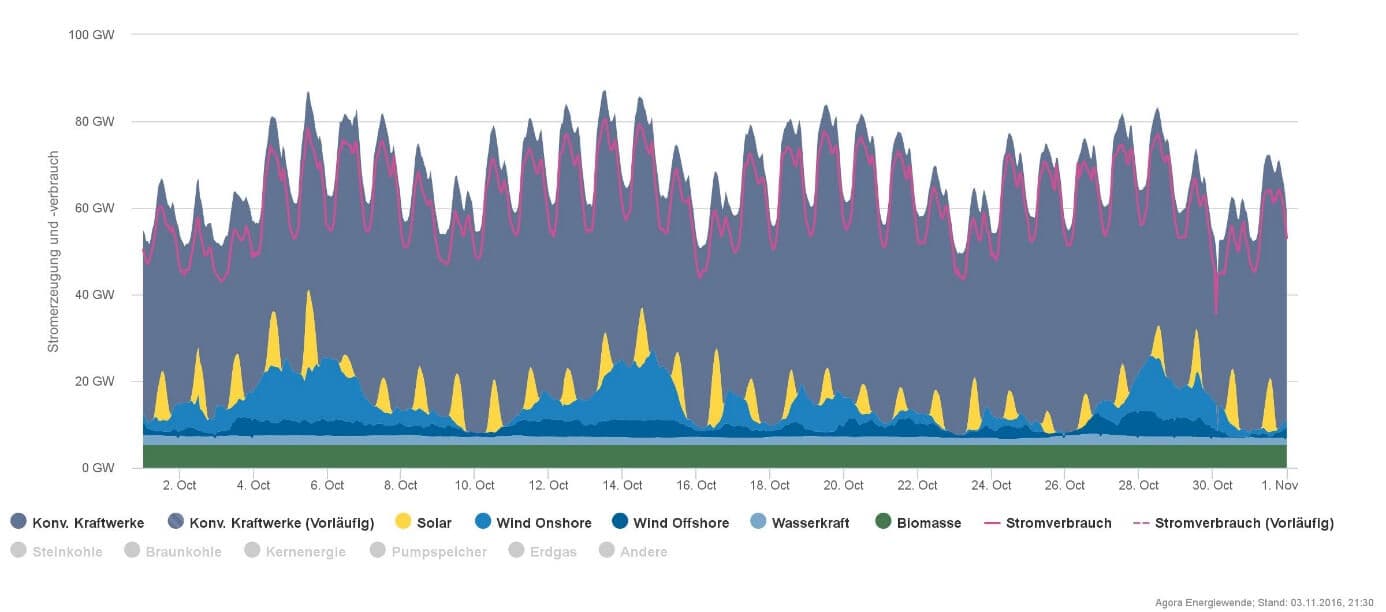
The situation described shows that, even as installed photovoltaic and wind capacity grows, periods with different characteristics will continue to alternate. During one, Germany will flood neighbouring countries with surplus wind and photovoltaic electricity and will have to curtail an ever-growing share of these sources. During the other, wind and solar sources will provide only minimal electricity. Germany will no longer have nuclear sources, so fossil sources will continue to dominate generation overall in the future.
This failure of the Energiewende’s emission-reduction objectives is discussed in more detail here. Whether and when the situation will change remains an open question.
The risk of shifting from coal to biomass in electricity generation
One further path to low-emission energy, which is beginning to gain ground in Europe, should also be mentioned. From an environmental perspective, however, it is at the very least highly questionable. Denmark, the United Kingdom and a number of other European countries are starting to convert coal-fired power plants to burn biomass. This is intended to be an important step towards reducing emissions and achieving environmentally friendly electricity generation. These countries do not have sufficient forests, so they import the necessary wood chips and pellets from abroad. There is thus a major risk that a large-scale shift from coal to biomass will have environmental impacts very similar to those caused by the use of, and intensive European subsidies for, biofuels made from palm oil.
Not only the turn of 2016 and 2017 in the European power sector clearly showed that weather-dependent wind and photovoltaic sources cannot replace fossil and nuclear sources, not only in Germany. Essentially from October to February, there were frequent periods of several days and weeks with almost no wind across large areas. During this period, solar power can supply only a minimum amount of electricity. Moreover, 2016 was also quite dry, and hydro resources, particularly in Austria, could generate electricity only in a limited mode. Alongside nuclear plants, fossil-fuelled power plants therefore had to be used very intensively. Although winter is generally windier, the winter conditions during this period were not that unusual. It is thus clear that wind and photovoltaic sources can be relied upon only to a limited extent in the future as well.
Germany and Denmark are therefore falling short of their declared targets for emission reductions and the replacement of coal-fired power plants. A complete shift from coal to gas is economically demanding and would reduce carbon dioxide emissions by only half. At least on paper, switching to biomass combustion reduces carbon dioxide production to zero. In reality, the situation is different. Emissions of pollutants and carbon dioxide from biomass combustion exist. However, it is assumed that the biomass will regrow and absorb the same amount of carbon dioxide that was produced in combustion. Formally, we thus obtain an emission-free source. One issue is that the growth of trees used to produce pellets can take many decades, and that is also the time needed to close the carbon dioxide cycle in this case.
The United Kingdom adopted legislation requiring very rapid carbon dioxide emission reductions. Its requirements cannot be met without completely ending electricity generation in coal-fired units. The United Kingdom envisages continued use of nuclear energy and construction of new nuclear units. However, the renewal of energy capacity, not only nuclear capacity, is severely delayed there. It therefore turned to converting coal-fired power plants to biomass combustion. Drax, a major coal-fired power plant, began gradually switching to wood combustion after 2012, and the company thus went from being one of the largest carbon dioxide emitters to one of the largest renewable electricity producers. Drax power plant’s total capacity is 4000 MWe. However, the United Kingdom does not have the wood needed to produce pellets for this electricity generation. Most of its forests disappeared during the first phase of the Industrial Revolution.
And the needs are not small: annually, they amount to a forest area exceeding the area of Central Bohemia and Prague. Producing half a million tonnes of pellets requires one million tonnes of wood, which under sustainable forest management requires an area of roughly 800 km2. Drax will need approximately 7.5 million tonnes of biomass in the form of pellets annually, meaning wood consumption from an area of roughly 12,000 km2. This figure naturally varies according to forest management practices; under a less intensive approach, the required area may be several times larger.
Wood material, mainly in the form of pellets, must therefore be imported from abroad. This is based on the experience of RWE, which burns pellets at several of its power plants across Europe and in the United Kingdom. The company built a pellet production plant in the US state of Georgia with an initial capacity of up to 750,000 tonnes of pellets per year, and imports from the United States continue to expand.
Following the launch of the project to “green” Drax power plant, further giant pellet storage facilities were built and millions of tonnes of wood began to be imported from around the world. Initially, biomass was only co-fired with coal, so biomass accounted for 35% in 2015; in 2016, the plant moved to 70% generation from pellets and gradually reached 100% use of wood. Most wood is imported by ship from North America.
Danish company Dong Energy (now Ørsted, editor’s note) has taken the same path, also gradually switching its power plants from coal to wood material. It has used pellets and wood chips at the Herning and Avedøre power plants since 2003. For example, its Asnæs power plant, with three units of 147 MW, 270 MW and 640 MW, is also gradually being converted to wood. The company is thus replacing coal with wood and since 2003 has reduced coal consumption from 6.2 million tonnes per year to just 1.7 million tonnes last year (the article was originally published at the end of 2017, editor’s note) at its two remaining coal-fired power plants. By 2023, it aims to burn only biomass. If it consumes around 7 million tonnes of wood material, more than 10,000 km2 of forest will need to be managed intensively and sustainably. Denmark does have a certain share of biomass from agricultural waste and food production. However, this is already fully consumed, mainly for heating purposes. Denmark therefore also imports the required wood material from abroad. So far, it has mainly come from Estonia, Lithuania, Latvia and Russia. Gradually, however, it is also turning increasingly to America.
Europe is the largest producer and consumer of pellets. In recent years, moreover, its consumption has risen rapidly, mainly because of their use for electricity generation. In 2014, just under 13.5 million tonnes of pellets were produced in Europe. The wood came mainly from northern Europe (Sweden, Finland and the Baltic states), but also from Germany and France. However, total demand was nearly 6 million tonnes higher, so the missing pellets had to be imported from North America (around 5 million tonnes), Russia and surrounding countries (around 1 million tonnes). And the gap between European production and demand continues to widen.
The aforementioned German company RWE is also converting coal units to burn wood pellets and chips at Amer in the Netherlands. Thanks to RWE, Germany itself is not merely considering using the conversion of coal-fired power plants to biomass combustion to meet its carbon dioxide emission-reduction targets. It sees this as a way to cover Germany’s need for stable energy sources and achieve emission reductions at an acceptable cost. While the number of coal units is relatively limited in the United Kingdom and Denmark, Germany currently has 50 GWe of coal-fired capacity. If these begin to switch to biomass on a large scale, it will mean a radical increase in wood material imports into Europe.
German politicians are now beginning to see clearly that the Energiewende cannot fulfil its declarations on reducing emissions or coal mining and imports. There is thus a major risk that they will follow their energy role model, Denmark, in shifting from coal to biomass as well. This is also because most green organisations declare a major biomass potential in their programmes and plans. Indeed, the energy strategies of Czech Greenpeace and Friends of the Earth Czech Republic also envisage a very large share of electricity generation from biomass. Even if the emission reduction achieved is merely formal and on paper, while the actual environmental impacts are, on the contrary, extremely negative. Yet not only green proponents of the Energiewende in Germany, Denmark and elsewhere will be able to declare its complete success.
There are thus considerable concerns that this could end in an even more dramatic disaster than the one associated with subsidised biofuels in Europe, palm oil and rainforest destruction in Indonesia. If only 15% of European coal units were converted to biomass combustion, roughly 200 million tonnes of pellets would be needed every year. If Germany and other countries truly follow the Danish energy strategy, forest destruction will be incomparably greater and will affect far broader areas around the world.
What does this mean for the Czech Republic?
The possibilities for using energy sources are strongly influenced by geographical and other conditions. The Czech Republic lies in the temperate zone, and weather patterns limit the potential use of solar energy (in more detail here). It is also not a coastal area with regular winds, so the use of wind energy is limited as well (in more detail here). Moreover, suitable windy areas are often environmentally valuable mountainous areas far from consumption centres. Even there, however, the capacity factor and thus the economic parameters of potential turbines do not reach the level of, for example, German turbines on the coast. Germany, where wind generation is strongly promoted, now obtains 13.3% from this source, but the dominant part of output is in the north near the coast. In Bavaria, which has roughly the same conditions as the Czech Republic, wind generates only just over one percent of Bavarian electricity. Based on the situation in Bavaria, it is therefore difficult to expect that a transition to low-emission electricity generation can be achieved through wind power supplying one-third of Czech electricity generation, together with gas. It should be recalled that wind generated only 0.55% of electricity in 2014. Czech opportunities to use domestic wind and solar sources are additionally limited by the situation in Germany. Stable weather suitable for these sources is usually common to the whole region, and when it occurs, the Czech power system is flooded with surpluses from Germany. When German renewable sources do not generate, Czech ones usually do not either. Czech wind sources can hardly compete economically with German coastal ones.
The potential of hydro resources in the Czech Republic has already been nearly exhausted, and biomass opportunities are also limited. The efficient and genuinely decentralised approach is to use bio-waste from agricultural and forestry production locally. But there is simply no room in the Czech Republic for the large-scale dedicated cultivation of energy crops that compete with food production and the ecological function of the landscape. Growing maize for subsidised biogas plants here or in Germany truly has nothing in common with an environmentally sound approach to the landscape and agricultural land.
Of the low-emission sources that can be used more extensively and could replace coal in the Czech Republic, only nuclear power remains (in more detail here). In 2014, nuclear power generated 35.3% of electricity in the Czech Republic and coal 51.6%. Renewables accounted for 10.6% in total. This shows that on the path towards low-emission energy, the Czech Republic needs to replace roughly half of its generation. It is true that around 19.7% of generated electricity was exported in 2014. This means that if exports were curtailed, fewer fossil sources would need to be replaced. Even in that case, however, generation equivalent to almost the entire output of the current nuclear units would have to be replaced. The Dukovany nuclear units, which have more than 2000 MWe in total and generate roughly 18% of electricity output, could operate for fifty to sixty years, i.e. for at least another twenty or even thirty years. However, Greenpeace is not the only organisation promoting the German path and seeking to start gradually closing individual Dukovany units now, after thirty years of operation. Its Energy [R]evolution document contains this as well. If anti-nuclear activists succeed, more than 60% of electricity would have to be generated from fossil fuels even if all electricity exports were eliminated.
It must be stressed that every nuclear megawatt-hour exported from the Czech Republic displaces a fossil megawatt-hour, mostly coal-fired, in Poland or Germany. Given the prevailing wind directions, it improves the environmental situation in Czech territory. If the Czech Republic wanted to make a significant contribution to strengthening low-emission energy in the region and reducing global carbon dioxide emissions, it should build nuclear units domestically and assist in constructing nuclear units in neighbouring countries. The expertise and industrial capacity available here could be applied in this way. This is partly happening in Slovakia, where Czech companies are significantly involved in completing two new units at Mochovce nuclear power plant.
Two years ago, the Czech Republic approved an update to its state energy strategy, which envisages the gradual replacement of coal-fired electricity sources by nuclear and renewable sources. If all relevant stakeholders could agree on its basis and jointly support its implementation, low-emission electricity generation could be built through completion of Temelín, gradual replacement of ageing Dukovany units, the most efficient possible use of local renewable potential predominantly in decentralised form, implementation of energy-saving opportunities and smart grids, and the potential for cooperation with neighbouring countries. If even a smaller part of environmental movements’ expectations for the potential of renewables and savings were realised, the Czech Republic could at least partly contribute to displacing coal from Germany and Poland. It could thus make a significant contribution to meeting the targets declared at the Paris climate conference.
Unfortunately, this vision is most likely unachievable because local environmental movements also make nuclear phase-out and following the German Energiewende their main priority, rather than implementing the energy strategies of France, Sweden or Ontario.
Conclusion
As we have sought to show, it is not appropriate to pursue drastic reductions in carbon dioxide production at any cost. On the other hand, if we decide that this is truly necessary, it cannot be achieved in the foreseeable future without intensive use of every available option. That means efficient and sensible savings, decentralised small-scale renewable sources, large renewable systems in locations suitable from geographical, climatic and other perspectives, as well as nuclear units. It is also necessary to strengthen high-voltage interconnections and energy cooperation among countries, and to introduce smart grids in a sensible and efficient manner.
Several medium-sized and large countries achieved a transition to low-emission energy based on a combination of nuclear and renewable sources as early as a quarter of a century ago. Power-sector emissions per unit of electricity generated in these countries are an order of magnitude lower than in Germany, for example, and carbon dioxide emissions per capita are also lower. At present, Germany’s carbon dioxide intensity is generally above 400 gCO2eq/kWh, while in France it is generally around 100 gCO2eq/kWh and in Sweden even only around 50 gCO2eq/kWh. They have shown that this path is possible. If transport and other sectors can be electrified, these countries have an open path towards low-emission energy overall. Germany will show whether, and if so when, it will be possible to achieve a path to low-emission energy without nuclear power under the conditions of the wealthiest country and extreme political and financial commitment. So far, however, this has not been achieved anywhere, apart from a few very specific cases with special natural conditions, such as Norway or Iceland.
The United Kingdom, by contrast, has chosen to follow France, Sweden, Switzerland, Slovakia and Ontario. It adopted very strict emission-reduction legislation and is seeking to move away from fossil sources in the power sector. It should do so precisely through a combination of renewable and nuclear sources. Given that nuclear power is under extreme pressure from anti-nuclear campaigning not only in the United Kingdom itself but across Europe, I am largely sceptical about implementation there.
China’s situation is favourable in this regard. Through a transition to low-emission energy, it needs to address its catastrophic environmental situation caused by pollutant emissions. China has decided to use every option it has to replace coal-fired power plants in electricity generation. However, three sources will be dominant: hydro, wind and nuclear. China currently generates roughly the same amount of electricity from nuclear power and wind. While wind capacity grew faster than nuclear capacity in previous years, the situation has now reversed. Wind faces problems connecting wind and industrial areas, while nuclear unit construction has reached a pace comparable to that seen in France in the 1970s. China is beginning to build 1000 MWe units serially and within five years. Once problems with connecting wind power plants are resolved, rapid growth in wind electricity generation could resume. According to the plan, China expects generation from wind power plants to remain roughly equal to that from nuclear units in the future, with these two sources, together with hydro, making the dominant contribution to cleaning up China’s power sector. China is also intensively building photovoltaic sources, helping to maintain photovoltaic panel manufacturing capacity even as the global boom in this field subsides. Given their capacity factor, however, generation from solar power plants is considerably lower than from the previously mentioned sources, and will remain so in the future.
It is clear that in the coming years it will be possible to compare the results of different strategies. It will then be possible to select the most effective approaches to the transition towards low-emission energy.
Note
This article is the fourth in a series examining the potential of individual energy sources in the Czech Republic, intended to initiate a discussion on the future development of the Czech power sector, its pitfalls and its opportunities. This is especially relevant because several years have passed since the last update of the energy strategy and, in practical terms, very little has been done in the Czech energy sector. At the same time, a number of risks are emerging, making it very important to gain an overview of energy developments and conditions both globally and in the Czech Republic. The first three parts were devoted to nuclear sources, wind energy and photovoltaic power plants.
The article was originally published on OSEL.CZ
Sdílejte článek prostřednictvím:
You might also like

10 August 2026, 09:33
9 August 2026, 14:38